Platelets (thrombocytes) are activated in response to injury and help wounds close quickly. However, if their activation is not properly controlled, they can trigger heart attacks and strokes, and contribute to tissue damage during infections. Until now, little was known about how the body maintains this delicate balance.
A research team from Medical Clinic I (Cardiology), led by Dr Leo Nicolai and Professor Steffen Massberg, together with first authors Lisa Laun, Alexander Leunig and Felix Zhang, has now identified a previously unknown protective mechanism in the spleen, publishing their findings in the renowned journal Science.
Quality control in the spleen
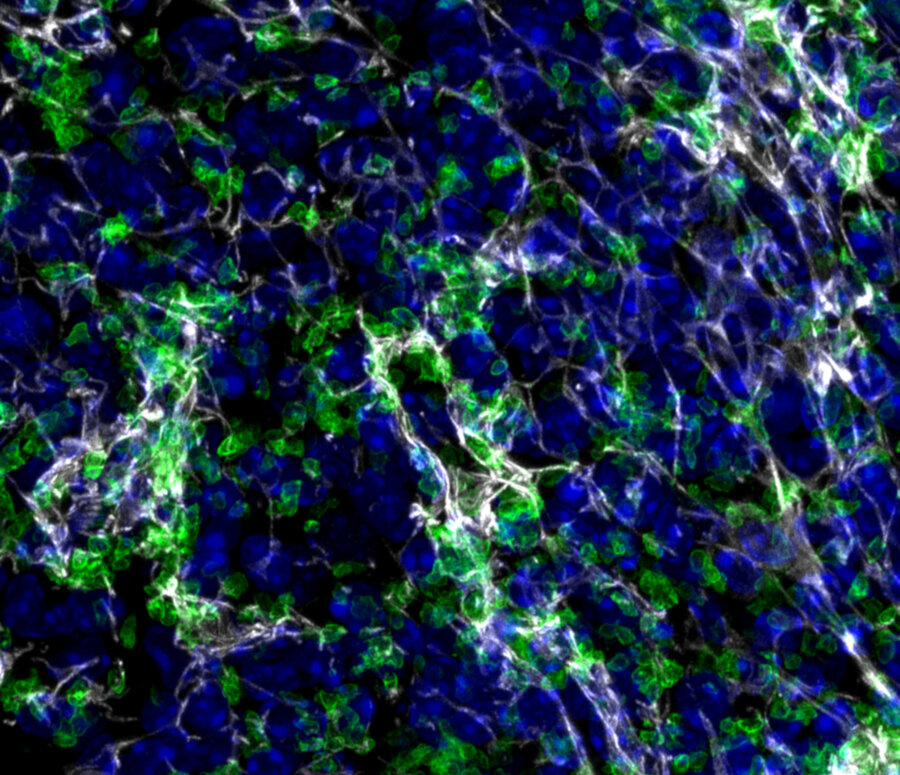
The researchers showed that the spleen functions rather like a quality-control checkpoint: resting platelets are allowed to pass on into the circulation, whereas platelets that are already strongly activated are retained in the spleen and removed. In animal models lacking this filtering mechanism, thrombosis, lung injury and pulmonary embolism were all more pronounced.
Corresponding evidence was also found in patients with myocardial infarction: in these situations, the spleen enlarges and accumulates activated platelets, suggesting that the protective mechanism also operates in humans.
The spleen as the final destination for over-activated platelets
At the molecular level, the researchers found that as platelets pass through the spleen, they receive activating signals from the splenic tissue. At the same time, the receptor G6b on the platelet surface sends inhibitory signals that counteract this activation. This allows resting platelets to return to the bloodstream.
In platelets that are already strongly activated, however, these inhibitory signals are no longer sufficient to offset the activation. These platelets remain activated, adhere within the spleen, and are subsequently removed there by specialised phagocytic cells.
The findings offer a possible explanation for why people without a spleen face an increased risk of blood clots and more severe disease courses during inflammation: they lack this natural protective filter.
Towards more targeted therapies against over-activated platelets
Millions of people take antiplatelet medications such as aspirin or clopidogrel to prevent heart attacks and strokes. Because these drugs inhibit the activation of all platelets, however, they often also raise the risk of bleeding. The newly discovered natural protective mechanism could, in the longer term, pave the way for more targeted therapies that selectively eliminate over-activated platelets while largely preserving normal blood clotting.
"Interestingly, this mechanism appears to play a role across a wide range of very different disease models, and could therefore offer new therapeutic targets for conditions such as sepsis or thrombosis," comments Dr Leo Nicolai. His team now plans to further investigate the potential therapeutic use of this mechanism in human disease.
Original publication:
Laun L, Leunig A, Zhang F, et al. Splenic regulation of systemic platelet activation state. Science. 2026;393(6817):eaec7230. doi:10.1126/science.aec7230


